Breaking Up with the Barbell
- Posted
- by Coach Jake
Breaking Up with the Barbell
The barbell is the single best piece of training equipment that exists. Full stop. The versatility, the ability to load and progress it, the sheer number of exercises you can do with it — it really is the bee’s knees.
I haven’t touched one in almost two years.
And at 50 years old, I look better and feel better than I ever have.
When the Solution Becomes the Problem
For me, the barbell started causing the exact problems it used to solve. This wasn’t an easy call. My bench numbers kept dropping because of shoulder pain. My squat numbers basically disappeared because of back pain from loading my spine. My elbows have real arthritis at this point, and my front rack position is gone — so front squats and cleans aren’t an option anymore.
Reading that, you’d assume I don’t squat, press, or clean anymore. I do all three. I just do them with zero joint pain.
I had to take my own advice and actually look at my training. And what I found was this: I was hurting after every barbell session, but my muscles were never sore, never even really fatigued. My back, shoulders, elbows, and knees were screaming — but the muscles I was actually trying to train weren’t getting the work.
The Begrudging Switch That Became a Love Affair
What started as a reluctant switch to dumbbells and kettlebells slowly turned into something close to a love affair, because I noticed something simple: I could actually do the exercises, and the thing limiting me was finally the body part I was trying to train.
Go figure.
Add to that the fact that I started putting on actual muscle — because now my muscles were the limiting factor in my training, not my joints — and my mind was genuinely blown.
The Barbell Isn’t the Villain — It Just Wasn’t Right for Me Anymore
Here’s the deal: maybe you love the barbell. That’s cool. I loved it too — kind of like I used to love things that were exciting but absolutely not good for me long-term. That’s the whole point of this series. We learn. We adjust.
If the barbell works for you, great. Keep using it. But if it doesn’t, there are options. So, so many options. Nearly anything you can do with a barbell, you can do with dumbbells.
We ran our entire gym through a six-week dumbbell hypertrophy program. The result: fewer injuries, more muscle, and zero loss in fitness. When it was time to get back under a barbell, plenty of athletes were excited to do it — but just as many had their eyes opened to a completely different tool.
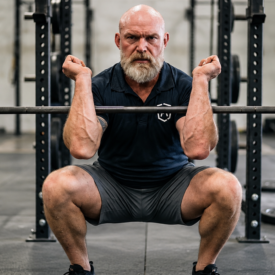
Now, on a squat day at our gym, roughly 75% of athletes are doing a traditional back squat. The other 25% are doing something else entirely — belt squats, goblet squats, kettlebell front squats, you name it. The exercise is just a means to an end. The only wrong answer is a lift that’s hurting you and keeping you from training.
The One Goal That Actually Matters As You Age
As you get older, you have exactly one primary training goal: be able to train tomorrow.
Everything else — the ego, the “real lifters do X,” the attachment to a specific bar in your hands — is secondary to that.
If you’re ready to find out what tool actually works for your body, that’s exactly what our dumbbell hypertrophy programs, Fenrir and Jörmungandr, are built for. Check them out below.