Front Squats and Wrist Pain: Why You’re Experiencing it and Modifications to Help
- Posted
- by Coach Jake
The Front Squat is a great exercise to build strength and hypertrophy, but it does require a good amount of wrist mobility. A lot of athletes struggle with it because it simply hurts their wrists too much.
Now if you’re a Cross Fitter or Olympic weightlifter, developing wrist mobility is extremely important and you’re going to have to learn how to front squat correctly with the standard grip.
But if you’re not too concerned with that and you’re doing a hypertrophy program (like the Lykos general fitness program or the Titan beginner program) or a strength program that doesn’t involve either of those, then there are some modifications and accommodations you can make for the front squat to reduce your wrist pain.
Either way, ideally you can set up in a good rack position which has direct carryover to the clean. This is ideal, but it’s not necessary.
Why You Are Experiencing Wrist Pain During Front Squats
Although the reasons can vary, wrist pain itself is one of the most common complaints heard during front squats. If you’re struggling with completing a front squat without pain, here are some of the main reasons why and where to start adjusting:
- Improper front rack position, often when you let the bar rest in your hands and not on your shoulders or when you’re leaning forward instead of staying upright. Your wrists become your main support, when they’re should just be used for balance.
- Too much tension in your grip. When you use too much tension or over-grip the bar, you’re transmitting that tension into your wrist, causing wrist pain.
- You have limited mobility, specifically in your shoulders and thoracic. If your shoulders or upper back is tight, it can cause wrist pain by shifting the bar forward as your upper back and shoulders are in the incorrect position for a front squat.
It could be those, or you could be exceeding your front rack capacity, dealing with limited wrist extension, or any combination of reasons.
Whatever the cause, you end up with the same result: wrist pain.
The 2 Main Modifications for a Front Squat to Decrease Wrist Pain During Training
If you are not training to become a professional athlete, here are some modifications you can make to your front squats to decrease your wrist pain:
#1. The Cross-Arm Position
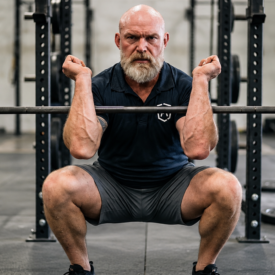
The first option is the classic bodybuilder cross-arm position. Instead of a traditional front squat rack position, you cross your arms like in front of you (see video above for demonstration). The downside is a lack of balance, making it hard to maintain a solid structure throughout the movement.
#2. Using Weightlifting Straps
For athletes struggling with wrist pain, the recommended solution is weightlifting straps. The strap has a loop on one side and is stitched shut on the other. Feed the stitched side through the loop and tighten it up, then repeat with the other strap.
Position the straps where the smooth part meets the knurling — slightly wider or narrower is fine. Tighten the straps and choke up as high as possible so the top of your hand is close to the barbell. Grip it like a hammer, then drive both elbows through.
This should let the barbell rest on your shoulders in a solid rack position. Because of the neutral hand position, there is little to no strain on the wrists.
If you’re doing front squats at high volume and experiencing wrist pain: loop the stitched side of the strap through the loop, grip like a hammer, choke up high, drive elbows forward, let the weight sit on the deltoids, and squat comfortably.
The Key: Following a Training Program That Aligns with Your Goals
Whether you’re training for the Olympics or working to improve your strength in everyday life, finding a training program and trainer that works for you is key, along with one that breaks down how to correctly execute the exercise or modifications and prevent injury.
If you are looking for an online training program to increase your strength, mobility, and dexterity, join us online here or in-person in South Austin or North Austin, TX.